Anne Brontë: The Quiet Revolutionary of Gothic Literature
When readers think of the Brontë sisters, they often remember Charlotte’s passionate heroines or Emily’s haunting vision of Wuthering Heights. Anne Brontë, the youngest of the three sisters, has long stood in their shadow. Yet modern scholars increasingly recognize that her quiet voice concealed one of the most radical literary minds of the era.
Rather than relying on dramatic Gothic spectacles or tragic romances, Anne confronted horrors that existed inside ordinary homes. Emotional abuse, alcoholism, manipulation, loneliness, and the legal power husbands held over their wives became the true monsters of her fiction.
More than two centuries after her birth on January 17, 1820, Anne Brontë’s novels continue feeling remarkably modern. Many readers now view her not only as an important Gothic writer but also as one of the earliest literary voices to argue openly for women’s independence and psychological dignity.
Growing Up in Haworth Parsonage
Anne Brontë was born on January 17, 1820, in the village of Thornton, Yorkshire. Shortly afterward, the Brontë family moved to Haworth Parsonage, where the surrounding moors would become one of the most influential literary landscapes in English history.
Tragedy shaped Anne’s childhood from an early age. Her mother died when Anne was only an infant, and two older sisters, Maria and Elizabeth, died after attending the harsh Clergy Daughters’ School at Cowan Bridge. These losses profoundly affected the surviving Brontë children and helped create the atmosphere of grief, solitude, and introspection that later permeated their writing.
Together with Charlotte, Emily, and their brother Branwell, Anne developed elaborate imaginary worlds filled with kingdoms, political intrigue, and richly detailed characters. These childhood stories became an extraordinary apprenticeship in fiction, allowing the siblings to develop their literary voices years before publication.
Life at Haworth was intellectually stimulating but emotionally isolated. The windswept Yorkshire moors, the nearby graveyard, and the quiet rhythm of village life created an environment where imagination flourished alongside constant reminders of mortality.
The Most Realistic of the Brontë Sisters
Anne’s literary approach differed significantly from those of Charlotte and Emily.
Emily embraced emotional extremes and symbolic landscapes, while Charlotte explored passionate inner lives shaped by social expectation. Anne instead turned her attention toward everyday reality.
Her fiction drew heavily upon direct observation. Having worked as a governess for several years, she understood the complex social hierarchy of Victorian households and the limited choices available to women without wealth or legal independence.
Rather than presenting Gothic terror through ghosts, supernatural events, or mysterious castles, Anne revealed something arguably more disturbing: the ordinary respectability behind which cruelty, addiction, manipulation, and psychological suffering could remain hidden.
This realism made her novels unusually controversial because readers recognized the society she described. The horrors she depicted existed not in distant medieval ruins but within respectable Victorian homes.
The Tenant of Wildfell Hall: A Victorian Revolution
Published in 1848 under the pseudonym Acton Bell, The Tenant of Wildfell Hall immediately challenged Victorian assumptions about marriage, morality, and women’s rights.
Its heroine, Helen Graham, arrives mysteriously at the isolated Wildfell Hall with her young son, refusing to explain her past. Gradually, readers discover that she fled an abusive marriage in order to protect both herself and her child from her husband’s alcoholism, infidelity, and moral corruption.
For Victorian audiences, the novel proved deeply unsettling. English law offered married women almost no independent legal identity. Leaving one’s husband, especially while taking a child, violated both social expectations and legal convention.
Anne nevertheless portrayed Helen’s decision as morally courageous rather than scandalous. Instead of condemning a woman who resisted abuse, the novel questioned the social system that left women so vulnerable in the first place.
Today, many literary historians regard The Tenant of Wildfell Hall as one of the earliest feminist novels in English literature because it directly confronted domestic violence, coercive control, addiction, and female autonomy decades before such subjects became widely discussed.
Agnes Grey and the Quiet Gothic
Before writing The Tenant of Wildfell Hall, Anne published her first novel, Agnes Grey, in 1847.
Based largely on her own experiences as a governess, the novel follows a young woman struggling to preserve her integrity while working for wealthy families who treat both servants and children with indifference or cruelty.
Unlike many Victorian novels, Agnes Grey contains very little outward drama. Its power comes from emotional observation. Anne carefully exposes the loneliness, humiliation, and moral compromises that often accompanied a governess’s life.
The novel also illustrates Anne’s distinctive approach to Gothic literature. Rather than relying upon haunted castles or supernatural mysteries, she found darkness within ordinary existence. Isolation, social inequality, and emotional neglect became forms of psychological imprisonment every bit as unsettling as traditional Gothic settings.
This restrained realism distinguishes Anne from many of her contemporaries and explains why modern readers increasingly view her work as psychologically sophisticated.
The Hidden Gothic of Anne Brontë
Anne Brontë rarely employed the supernatural, yet her novels remain deeply connected to the Gothic tradition.
Her stories replace ghosts with guilt, castles with isolated manor houses, and physical imprisonment with emotional oppression. The source of terror is not the unknown but the familiar.
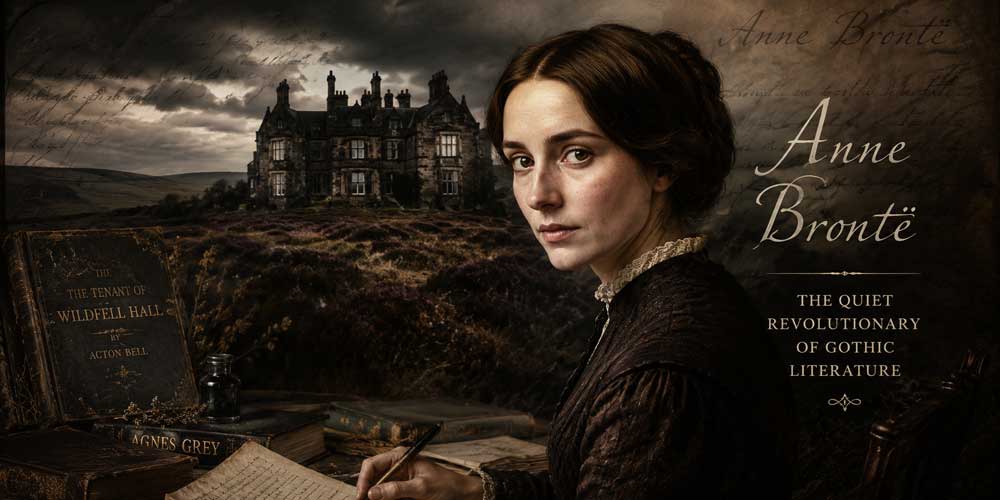
Wildfell Hall itself embodies this approach. The decaying mansion overlooking an isolated landscape creates an atmosphere of mystery long before readers understand Helen Graham’s past. Like many Gothic houses, the building appears to preserve painful memories that refuse to disappear.
Anne understood that the greatest horrors often emerge not from supernatural forces but from ordinary people capable of manipulation, addiction, cruelty, and emotional control. In this sense, her fiction anticipates the psychological Gothic that would flourish in the twentieth century.
Her novels ask readers to recognize that evil does not always announce itself dramatically. Sometimes it enters quietly through respectability, social convention, and everyday domestic life.
Lesser-Known Facts About Anne Brontë
Although Anne is frequently described as the quietest Brontë sister, her life contains many surprising details.
Like Charlotte and Emily, she originally published under a masculine pseudonym. She became Acton Bell, while her sisters wrote as Currer and Ellis Bell. The three women believed female authors would struggle to receive serious critical attention in Victorian England.
Anne was also the only Brontë sister to have worked extensively outside the family home for several different employers. Her experiences as a governess provided firsthand knowledge of class divisions, child-rearing practices, and domestic abuse that later became central to her fiction.
Perhaps most remarkably, Charlotte Brontë herself initially suppressed the republication of The Tenant of Wildfell Hall after Anne’s death. Believing the novel too shocking for Victorian readers, Charlotte limited its circulation for many years. As a result, Anne’s literary reputation remained overshadowed for generations despite the novel’s extraordinary originality.
Only during the twentieth century did scholars begin fully recognizing the importance of Anne’s work, particularly her exploration of women’s legal rights, psychological trauma, and moral independence.
A Voice Far Ahead of Its Time
Anne Brontë died of tuberculosis on May 28, 1849, at only twenty-nine years of age.
She was the first of the surviving Brontë siblings to die, leaving behind just two completed novels and a collection of poetry. Although her literary career lasted only a few years, it demonstrated a remarkable willingness to confront subjects that many Victorian writers preferred to avoid.
Anne refused to romanticize destructive behavior or soften the realities of domestic abuse, addiction, and emotional manipulation. She believed literature should tell the truth about human experience, even when that truth made readers uncomfortable.
At the time of her death, few could have imagined that the quiet youngest sister would one day be regarded as one of the nineteenth century’s most progressive novelists. Her greatest recognition would arrive not during her lifetime, but generations later.
Anne Brontë’s Enduring Legacy
For decades after her death, Anne Brontë remained the least celebrated member of one of literature’s most famous families. Readers admired Jane Eyre and Wuthering Heights, while The Tenant of Wildfell Hall received comparatively little attention, partly because Charlotte Brontë discouraged its republication after Anne’s death.
During the twentieth century, however, literary scholars began reassessing Anne’s achievement. Rather than viewing her realism as less imaginative than Emily’s or less passionate than Charlotte’s, critics increasingly recognized it as her greatest strength.
Today, The Tenant of Wildfell Hall is widely regarded as one of the earliest feminist novels in English literature. Its exploration of coercive control, alcoholism, women’s legal vulnerability, and psychological resilience anticipated social debates that would not become widespread until many decades later.
Anne’s influence extends beyond feminist literature. By locating Gothic terror within ordinary domestic life, she helped shape the development of psychological fiction, demonstrating that the most frightening monsters are often neither supernatural nor imaginary but painfully human.
More than two centuries after her birth, Anne Brontë is no longer remembered simply as the youngest Brontë sister. She stands as an original literary voice whose quiet realism permanently expanded the possibilities of Gothic and Victorian fiction.
Wear the Darkness
If Anne Brontë’s quiet Gothic world speaks to your love of Victorian literature, dark aesthetics, and timeless storytelling, explore the Edgar Allan Poets store. Our designs celebrate Gothic literature, Edgar Allan Poe, classic authors, and the beauty of the darker imagination.

Frequently Asked Questions
Why is Anne Brontë considered ahead of her time?
Anne Brontë openly addressed domestic abuse, alcoholism, women’s legal rights, and emotional manipulation decades before these subjects were widely discussed in Victorian literature. Many scholars now regard The Tenant of Wildfell Hall as one of the earliest feminist novels in English.
What is Anne Brontë’s most famous novel?
The Tenant of Wildfell Hall, published in 1848 under the pseudonym Acton Bell, is her best-known work. It follows Helen Graham, a woman who escapes an abusive marriage to protect both herself and her son.
How does Anne Brontë differ from Charlotte and Emily Brontë?
While Charlotte emphasized emotional passion and Emily embraced symbolic Gothic landscapes, Anne focused on psychological realism. Her novels explore the hidden suffering of ordinary domestic life rather than dramatic or supernatural events.
Did Anne Brontë write Gothic literature?
Although she rarely used ghosts or supernatural elements, Anne employed many Gothic themes, including isolation, repression, decaying houses, psychological conflict, and moral darkness. Her work helped shape the development of psychological Gothic fiction.
Why was Anne Brontë overlooked for so long?
After her death, The Tenant of Wildfell Hall was not widely republished for many years, partly because Charlotte Brontë considered its subject matter too controversial. As a result, Anne’s literary achievements remained overshadowed until twentieth-century scholars reassessed her work.