The Organ: The Most Gothic Instrument
Few musical instruments inspire the same mixture of awe and unease as the pipe organ. Its sound can feel majestic, sacred, and transcendent. Yet the very same notes can evoke darkness, isolation, mystery, and fear. For centuries, the organ has occupied a unique place in the cultural imagination, standing at the intersection of beauty and terror.
This duality explains why the instrument became one of the defining symbols of Gothic culture. Whether echoing through medieval cathedrals, accompanying silent horror films, or emerging from the shadows of Gothic music, the organ possesses a dramatic power unlike any other instrument. Its immense scale, haunting timbre, and historical associations make it perfectly suited to the Gothic fascination with death, mystery, spirituality, and the sublime.
More than a musical instrument, the organ became a symbol of the Gothic imagination itself.
From Cathedrals to the Gothic Imagination
The organ’s connection to Gothic culture begins with architecture.
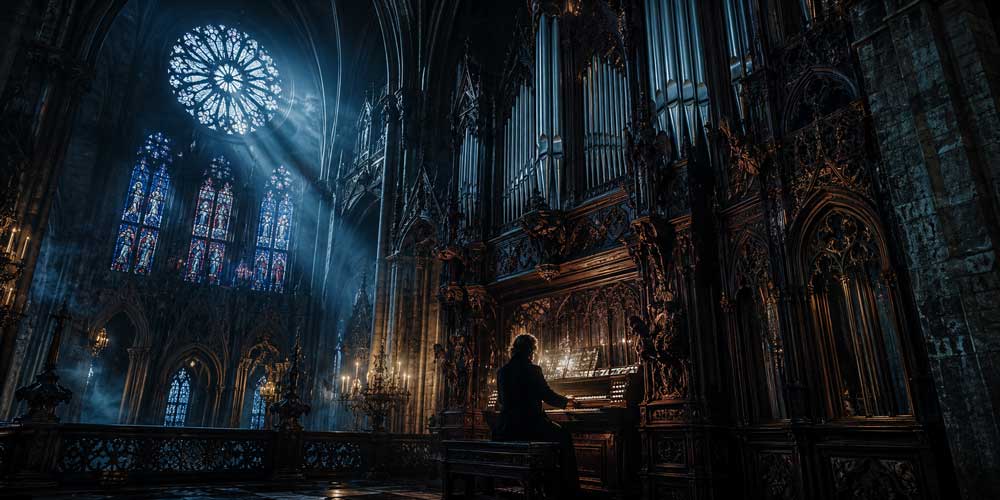
For centuries, the instrument served as the dominant voice of Europe’s great cathedrals. Massive pipe organs were built into structures already designed to inspire wonder through soaring arches, stained glass, and immense vertical spaces. The instrument’s sound filled these environments with an almost supernatural presence.
Unlike smaller instruments, the organ seemed capable of transforming an entire building into part of the performance. Notes reverberated through stone corridors, echoed beneath vaulted ceilings, and lingered long after the keys had been released.
This relationship between architecture and sound helped establish the organ as an instrument associated with mystery, spirituality, and forces larger than ordinary human experience.
Long before Gothic literature emerged as a genre, the organ was already creating the emotional atmosphere that Gothic artists would later seek to capture.
The Sound of the Sublime
One reason the organ feels inherently Gothic is its connection to the sublime.
Eighteenth-century philosopher Edmund Burke described the sublime as an emotional experience that combines awe with fear. Unlike simple beauty, the sublime confronts individuals with something vast, powerful, and difficult to fully comprehend.
Few instruments embody this idea more effectively than the organ.
Its enormous dynamic range allows it to move from delicate whispers to overwhelming walls of sound. A single performance can feel intimate one moment and terrifying the next.
This emotional duality appears throughout organ music, particularly in compositions such as Johann Sebastian Bach’s Toccata and Fugue in D Minor, whose dramatic opening has become one of the most recognizable sounds associated with Gothic culture.
“The sublime is the strongest emotion which the mind is capable of feeling.”
— Edmund Burke, A Philosophical Enquiry into the Origin of Our Ideas of the Sublime and Beautiful
The organ’s ability to evoke both wonder and dread makes it a natural expression of the sublime. This emotional tension lies at the heart of the Gothic aesthetic.
The Organ and the Uncanny
Beyond its association with the sublime, the organ also possesses a deeply uncanny quality.
Sigmund Freud described the uncanny as the unsettling sensation produced when something feels simultaneously familiar and strange. The organ often creates exactly this effect.
Its sound resembles the human voice in certain registers, yet it remains unmistakably mechanical. It can seem to breathe, whisper, moan, or roar, creating the impression that the instrument itself possesses a strange form of life.
This ambiguity has fascinated Gothic artists for generations. The organ feels human without being human. It appears alive while remaining an elaborate machine.
As a result, its music frequently produces the same emotional uncertainty that characterizes Gothic fiction, where familiar realities become strange and hidden forces seem to lurk beneath the surface of ordinary life.
“The uncanny is that class of the frightening which leads back to what is known of old and long familiar.”
— Sigmund Freud, The Uncanny
The organ’s ability to occupy this boundary between the familiar and the mysterious helps explain its enduring presence throughout Gothic culture.
The Organ in Gothic Literature
When Gothic writers sought symbols capable of expressing mystery, spirituality, death, and emotional intensity, the organ naturally found its place within their stories.
Victor Hugo’s The Hunchback of Notre-Dame presents one of the most famous literary examples. The cathedral itself functions almost as a living character, and the organ contributes to its atmosphere of grandeur, isolation, and spiritual power.
The instrument also appears throughout nineteenth-century Gothic literature as a symbol of hidden emotions, religious conflict, mourning, and supernatural possibility.
Its sound often emerges from unseen spaces, echoing through dark halls and ancient buildings. In doing so, it becomes more than background music. It becomes part of the architecture of fear itself.
The Organ in Horror Cinema
The transition from Gothic literature to Gothic cinema carried the organ into an entirely new medium.
During the silent film era, theater organs accompanied screenings, providing emotional intensity and dramatic atmosphere. Organists could shift instantly from romance to terror, making the instrument ideally suited to stories involving monsters, haunted castles, and supernatural threats.
As horror cinema evolved, the organ remained one of its most recognizable musical symbols. Even audiences with little knowledge of classical music came to associate its sound with vampires, ghosts, ancient curses, and Gothic architecture.
Part of this connection emerged from the instrument’s historical associations. Because the organ already carried centuries of religious and funerary symbolism, filmmakers could evoke a sense of mystery and dread almost immediately by incorporating its sound into a scene.
The result was a powerful cultural shorthand that remains recognizable today.
The Phantom of the Opera and the Gothic Organ
Few Gothic stories are more closely associated with the organ than Gaston Leroux’s The Phantom of the Opera.
The Phantom inhabits hidden chambers beneath the Paris Opera House, creating music from the shadows while existing between genius and monstrosity. His relationship with music reflects many of the themes that define Gothic fiction: isolation, obsession, secrecy, longing, and emotional excess.
The organ is not merely a decorative detail. It functions as an extension of the Phantom himself. Its voice fills spaces where the character cannot openly appear, allowing music to express emotions that words cannot.
The image of a solitary figure performing dramatic organ music in a cavernous underground chamber has become one of the most enduring visual motifs in Gothic culture.
It captures the instrument’s ability to transform sound into atmosphere and atmosphere into storytelling.
Why Gothic Musicians Still Use the Organ
Despite changing musical trends, the organ continues to occupy a prominent place within Gothic and dark alternative music.
Part of its appeal lies in its emotional range. The instrument can sound mournful, majestic, mysterious, spiritual, or threatening without losing its distinctive character.
Artists working in Gothic rock, darkwave, neoclassical dark music, and cinematic compositions frequently draw upon organ textures because they immediately evoke a sense of atmosphere and historical depth.
Unlike many modern electronic sounds, the organ carries centuries of cultural memory. Listeners unconsciously associate it with cathedrals, rituals, funerals, ancient buildings, and forgotten histories.
These associations make it uniquely effective for music that seeks to explore themes of mortality, nostalgia, spirituality, and emotional darkness.
The Organ and Other Gothic Instruments
Many instruments contribute to Gothic music and imagery.
The violin expresses longing and tragedy. The cello conveys depth and melancholy. Church bells evoke ritual and mortality. Pipe organs, however, occupy a category of their own.
Unlike most instruments, the organ combines immense physical scale with extraordinary emotional versatility. It can dominate an architectural space while simultaneously producing intimate and fragile passages.
It also bridges several symbolic worlds at once. The organ belongs to religion, yet frequently appears in horror. It represents beauty while evoking fear. It suggests transcendence while remaining deeply connected to death and mourning.
Few artistic symbols unite so many seemingly contradictory qualities so effectively.
This unique combination helps explain why the organ became the instrument most strongly associated with Gothic culture.
Why the Organ Remains Gothic
Few artistic symbols embody the Gothic imagination as completely as the pipe organ.
Its history stretches across centuries of religious ritual, monumental architecture, literature, cinema, and music. Throughout that journey, the instrument has retained a unique ability to evoke emotions that seem contradictory yet deeply connected: awe and fear, beauty and darkness, transcendence and mortality.
The organ became Gothic not simply because it appears in cathedrals or horror films, but because its sound reflects the emotional tensions at the heart of the Gothic tradition itself. It can feel sacred and unsettling at the same time. It can suggest comfort while hinting at hidden mysteries beyond ordinary understanding.
From the vast cathedrals of Europe to the haunted landscapes of Gothic fiction, from silent cinema to contemporary dark music, the organ has remained a powerful symbol of the sublime, the uncanny, and the unknown.
Its voice continues to resonate because it reminds us that beauty and darkness are not always opposites. Sometimes they exist together, creating the emotional complexity that defines the Gothic experience.
Wear the Darkness
If you are fascinated by Gothic culture, dark aesthetics, classic horror, and the symbols that continue shaping the Gothic imagination, explore the Edgar Allan Poets store for apparel inspired by literature, mystery, and the beauty of darkness.

Frequently Asked Questions
Why is the organ associated with Gothic culture?
The organ is associated with Gothic culture because of its historical connection to cathedrals, its dramatic sound, and its ability to evoke mystery, awe, spirituality, and fear.
What makes the organ sound Gothic?
Its enormous dynamic range, haunting timbre, and centuries of cultural associations with religion, death, and the supernatural contribute to its distinctly Gothic character.
What is the most famous Gothic organ composition?
Johann Sebastian Bach’s Toccata and Fugue in D Minor is often considered the composition most strongly associated with Gothic imagery and horror culture.
Why does the organ appear so often in horror films?
The instrument immediately creates atmosphere and carries strong associations with cathedrals, mystery, death, and the supernatural, making it an effective tool for horror storytelling.
Do modern Gothic musicians still use the organ?
Yes. Many Gothic, darkwave, neoclassical, and cinematic artists continue using organ sounds because they provide emotional depth, historical resonance, and a distinctive Gothic atmosphere.